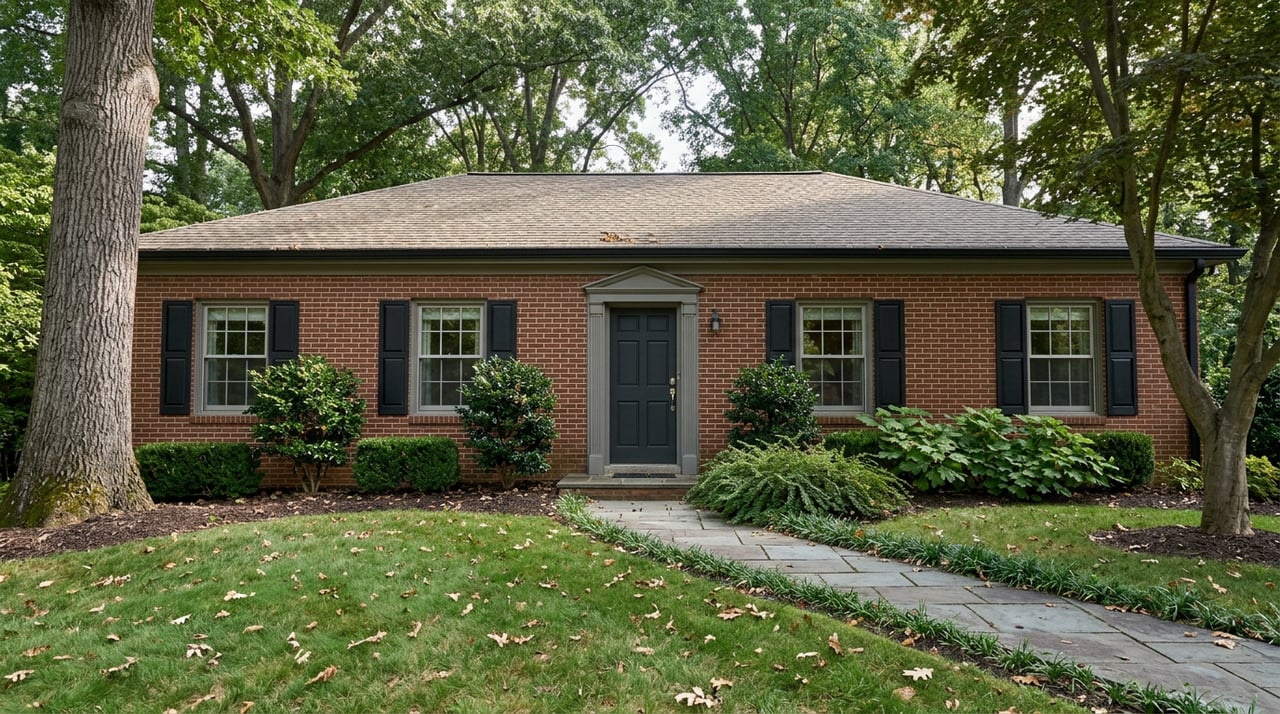
A buyer walks the back third of an acre in an established Dunwoody neighborhood, the kind of half-wooded lot with a 1970s brick ranch that everyone in this market is circling for a teardown. The listing agent has already said the magic words: no tree permit required for single-family lots. The buyer's contractor pencils out a footprint, a pool, a driveway wide enough for three cars, and mentally clears every hardwood standing between the house pad and the property line.
That plan is the mistake. Not because the city will stop them with a permit application, but because Dunwoody's tree ordinance was never built around permits for single-family lots in the first place. It was built around density. And density doesn't care whether you filed paperwork.
The exemption that isn't an exit
Dunwoody's tree preservation standards live in Chapter 16, Division 6 of the city's Code of Ordinances, adopted to manage flooding, erosion, noise, and glare as the city grew. The mechanics are specific: non-residential and multi-family lots need a permit to remove hardwoods at 10 inches or more in diameter at breast height, softwoods at 20 inches or more, and understory trees at 6 inches or more. Single-family homeowners are exempt from that permit requirement entirely.
Read that sentence again, because it's where most teardown math goes wrong. The city's own permitting guidance is explicit that single-family lots don't need a removal permit, but it pairs that exemption with a second requirement in the same breath: those lots must still maintain a minimum tree density on the site. The permit disappears. The density obligation does not.
That distinction matters because a permit is a one-time gate you clear before you act. A density requirement is a standing condition you have to satisfy after you're done clearing, grading, and pouring a foundation. A buyer who treats the exemption as blanket permission to clear a lot down to dirt can find themselves out of compliance with density rules they never had to apply for, discovered only when the city's inspectors show up for a certificate of occupancy.
The buffer that doesn't move for your site plan
The second piece of the ordinance is less forgiving than density, because it isn't negotiable by design. Any tree inside a 75-foot buffer along a stream is off-limits for removal without prior approval from the City Arborist, and that approval is typically reserved for trees that are dead, dying, or genuinely hazardous. It doesn't matter whether the lot is zoned single-family or whether the homeowner exemption applies elsewhere on the property. The buffer is a hard line.
For a buyer evaluating an older Dunwoody lot that backs up to a small tributary, drainage easement, or anything that shows up as a blue line on a topographic map, this is the detail that can quietly erase the rear-yard buildable area they assumed they had. A half-acre lot with a 75-foot no-touch zone along the back property line isn't really a half-acre lot for building purposes. It's whatever's left after you subtract the buffer, and that number doesn't show up on a listing sheet.
This is the part of due diligence that a general home inspection will never catch, because a home inspector is looking at the house, not the tree canopy or the hydrology map. It has to be checked separately, and it has to be checked before the due diligence window closes.
Why the paperwork side changed too
None of this is happening in a permitting system frozen in amber. Dunwoody's Community Development operations moved off its old permitting platform, iWorQ, and onto CentralSquare in August 2025, which changed how residents submit applications, schedule inspections, and track code complaints. Anyone whose contractor is still working from an old bookmark or an outdated PDF checklist is applying through the wrong door.
Layered on top of that, a countywide update to the state minimum building code took effect January 1, 2026, and Dunwoody administers that code locally, meaning any renovation or new construction plan needs to be checked against the current version rather than whatever a contractor last used two or three years ago.
The fee structure is current as of an April 2026 review of the city's building permit guide: residential construction permits carry a $175 minimum for projects valued under $75,000, new residential construction runs roughly $6 per $1,000 of valuation, and component permits carry a $50 minimum. Reinspections run $50 an hour with a one-hour minimum, and building without a permit doubles the fee outright. None of this is exotic by Atlanta-metro standards, but a buyer pricing out a teardown who is working from an old fee schedule, or worse, from a generic county-wide estimate, is budgeting against the wrong numbers.
Where this actually gets solved: the due diligence window
Georgia's due diligence period is a negotiated stretch of the contract, commonly somewhere between 7 and 14 days, during which a buyer has the right to walk away for any reason and recover earnest money. It exists precisely for situations like this: to give a buyer room to investigate something a listing can't fully disclose before the deal is binding.
For a Dunwoody teardown or major addition, that window is where a tree density check and a stream buffer determination belong, not after closing. A buyer who wants a straight answer on whether a lot's tree density is already compliant, or where exactly a stream buffer falls relative to a proposed footprint, can request a site consultation from the City Arborist's office during due diligence rather than assuming the listing agent's "no permit needed" line covers the whole picture. It's a phone call and a site visit that costs nothing but a few days of the window a buyer already has, and it's the difference between designing a house around the actual buildable envelope and redesigning one after the city flags a density shortfall mid-project.
The same logic applies to permitted work already done on a property. If a seller finished a basement, added a sunroom, or extended a driveway without pulling the right permit under the old iWorQ system, that gap doesn't disappear just because the city switched platforms. It shows up the moment a buyer applies for their own permit and the file doesn't match what's on the ground.
What this means if you're shopping an older Dunwoody lot
The neighborhoods where this matters most are the ones built out decades before the tree ordinance existed, where mature canopy is exactly what makes a street desirable and exactly what a teardown buyer has to work around. A lot that reads as heavily wooded on a drive-by can be carrying both a density obligation and a buffer restriction at the same time, and the two interact. A buyer who clears aggressively to hit a density-safe margin on the buildable side of the lot can still run headlong into a buffer they didn't map first.
None of this means these lots are bad buys. It means the ordinance rewards buyers who treat the tree canopy as a site condition to survey, not a landscaping detail to clear later. A pre-offer conversation with a contractor who already works inside Dunwoody's current permitting system, paired with an Arborist consultation during due diligence, turns an assumption into a number before it becomes a change order.
Frequently asked questions
Does the single-family exemption apply to every residential lot in Dunwoody, including corner lots and lots in the Dunwoody Village Overlay? The exemption applies to the tree removal permit requirement for single-family residential lots generally, but overlay districts and specific zoning categories can carry their own additional review layers. A buyer should confirm overlay status with the city's Community Development department before assuming a standard exemption applies.
Who do I actually call to find out where a stream buffer falls on a specific lot? The city's tree regulations are administered through Community Development, and buffer or density questions can be directed to the City Arborist's office, which is the authority on-site determinations run through.
What happens if a previous owner cleared trees without permission inside the buffer? That becomes a code compliance question rather than a permitting one, and it's worth asking the seller directly, since unpermitted clearing in a protected buffer can carry its own remediation requirements that follow the property, not the person who did the clearing.
Can I get a density and buffer determination before I write an offer, not just during due diligence? Nothing prevents a prospective buyer from requesting general information before a contract is signed, though a site-specific determination typically requires access to the property, which is easier to arrange once there's an accepted offer and a due diligence period in place.
Older Dunwoody lots carry real value precisely because of the trees that make the ordinance relevant in the first place. Understanding where the rule bends and where it doesn't is what turns a promising lot into a project that actually gets built the way it was drawn. If you're evaluating a teardown or a major renovation anywhere in Dunwoody, the Barnes Young Team can walk the site with you before you write an offer. Schedule a consultation to discuss your next move.